Posts

Showing posts with the label inclusion

Best Buddies

Image
  Each year our IU gives out an award to deserving educators that support the integration of students with disabilities into a regular education. It never ceases to amaze me how creative and dedicated both students and staff can be to make innovative programs like these succeed. Below is a summary of the Best Buddies program at Stroudsburg Junior High School given by Marc Bernstein, CIU 20 Supervisor of Multi-disabilities Program. Every year on orientation day, our IU gives out prestigious awards for different accomplishments. This year, I have the honor to present the Maureen Crawford Award. This honor is awarded in memory of Maureen Crawford, a strong proponent of the inclusion of all students, to a deserving person or persons, who have worked collaboratively to include special needs students in the broader community. “Everything that can be counted does not necessarily count; everything that counts cannot necessarily be counted.”- Albert Einstein After being ins...

Reading Apprenticeship

I attended the Reading Apprenticeship Winter Conference and was asked to be a part of the panel discussion at the conclusion of the conference. Here's a preview of the key points of my presentation: Reading Apprenticeship (RA) is much more than content area literacy. If you are "doing" RA you are addressing Inclusion, 21st Century Skills, Principles of Effective Instruction, Higher Order Thinking Skills, Secondary Response-to-Intervention, Questioning, High School Reform, Differentiated Instruction, Adolescent Literacy and more. To ensure RA gets the time and resources it needs, it is wise to have RA permeate as many school planning documents as possible e.g strategic plan, school improvement, Special Education Plan, LRE Plan, Professional Education Plan, Induction Plan, etc.....

10,000 Hours to Success

Image
Malcolm Gladwell, bestselling author and staff writer for the New Yorker, has a magic number for success. In his latest book, Outliers: The Story of Success ,  Gladwell makes a compelling case for explaining success. Turns out factors such as innate ability do not factor into success as much as we might think. Turns out practice.... 10,000 hours of practice to be exact translates into success. From Bill Gates to Mozart to the Beatles and grandmaster chess champions, Gladwell uses the 10,000-Hour Rule again and again to explain their success. It's not that innate ability isn't a factor, it just isn't a determining factor. For a sneak peek at how Gladwell unravels his theory read the excerpt below: A research study comparing amateur and professional pianist "couldn't find any naturals that float to the top while practicing a fraction of the time their peers did. Nor did they find any grinds , people who worked harder than everyone else, but just didn't h...

New Services

Image
Colonial Intermediate Unit 20 welcomes our newest consultant, Michelle Davis, to the Curriculum Department. Michelle will have a unique place on our team. Her position is designed to be a blend of special education, differentiated instruction and educational technology. The demand for this position stems from the steady increase in requests for assistive technology support for students with learning disabilities. The increase in requests coincides with advances in technology such as voice recognition, screen readers, spell check, podcasting, smart boards...etc. Michelle will help to facilitate teams, usually the IEP team, to identify barriers students have to learning and subsequent technology tools that will support student success in the inclusive setting. The emphasis will be on using technology tools already available to support student achievement. For example, last year we had a student whose disability created a barrier to conducting an oral presentation to his class. The te...

Planning for Differentiation

Image
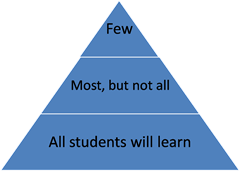
An article in the Washington Post, Schools Look At Providing More Time For Teachers caught my eye recently which looks at teacher planning time. As you might imagine, teachers feel they lack planning time.... and they may have a point. The amount of planning time has stayed constant while requirements for inclusion and accountability have increased. My question is do we design curriculum to address these challenges from the onset or do we expect teachers to plan lessons, adjust their instruction for a variety of diverse learners, grade assignments, connect with parents and other colleagues, make copies in a 40 minute planning period? Why not differentiate the curriculum from the beginning? The graphic to the left depicts the Curriculum Planning Pyramid (Schumm, Vaughn, & Leavell, 1994) which represents how curriculum might be organized to meet the needs of all learners. The base represents the most important concepts you want ALL STUDENTS to learn. The middle layer represents...

Co-Teaching: Success from the Field

Lisa Parisi is a 5th grade teacher who has worked in a co-teaching setting for the last three years. Read her recent post, A Perfect Storm , to unlock the mystery of co-teaching success. Follow up with additional information on Universal Design for Learning (UDL) and Lisa's presentation on Project-based Learning from the K-12 Online Conference - scroll down to the bottom of the page and click on the play button embedded in the picture.

High Expectations for ALL

At the Transition Conference two summers ago I saw Larry Gloeckler, Executive Director of the Special Education Institute at the International Center for Leadership in Education . He indicated that it was not enough for schools to say they had high expectations for ALL students. Rather, schools need specific strategies for helping teachers, parents, and students institutionalize high expectations. Words are easy, but do people really believe it? Do they really believe ALL students can learn at high levels? In my experience, it is difficult for most educators to make this transition. It's easy to see the flaws, the deficits that students bring which convince us it can't be done. I wonder how far we could push achievement if instead of the unimaginative, typical response of "it can't be done," we instead gave consideration to how it could. Carol Ann Tomlinson, guru for differentiated instruction refers to this as Teaching Up . How could we teach Algebra to specia...