Posts

Teacher Leadership: What do we Know?

Context for the Research: In a recent Learning Forward article, Joellen Killion summarized some exciting new research regarding teacher leadership. This body of work extends a similar study and basically delineates what we know about teacher leadership over the last 30 plus years. Findings: Interestingly, the findings from the most recent study paralleled those from the earlier work. Most research studies fail to adequately define teacher leadership. None of the studies linked teacher leadership directly to student learning. Four themes emerged as either facilitators or inhibitors to teacher leadership: Adequate Time Quality of relationships with peers and administrators Climate and structural factors Personal characteristics Connection to Practice: Teacher Leaders need time to plan, collaborate and reflect on next steps. Without planning, little will be accomplished. Provide time for planning and collaboration. Do not assume it will happen with...

Failure to Launch

Wenner and Campbell define teacher leaders as: “teachers who maintain K-12 classroom-based teaching responsibilities, while also taking on leadership responsibilities outside of the classroom” (p. 140). We often assume teachers implicitly understand this dual role of being an effective teacher as well as a leader. They don’t. Over the past fifteen years, I have been a part of numerous projects, which sought to build capacity through teacher leaders. An unfortunate pattern emerged across projects.  The selected educators would embrace the new ideas and/or practices in their classrooms, with their students. However, when asked to take an active leadership role, most would either avoid the task, provide a litany of reasons why the task could not be accomplished or provide a half-hearted initial effort with little follow through. Now we did have success stories, but too many teacher leaders were falling through the cracks. Why? How can we improve outcomes? Three Rul...

What’s Up?

I’m baccckkkkk!  For the last six years, I worked at Discovery Education. They kept me super busy working with partners across the country as well as Canada and Egypt. I ended up with little time to write and blog. However, I have recently left Discovery and thought what better way to commemorate my time than to document the biggest lessons I have learned during my tenure. Not sure how many posts I have in me, but I am excited to get started.

Resources for Staff Development

A blog post by Elliot Seif from ASCD’s the Edge caught my eye today. The author lists a variety of journal articles that support staff development for a variety of purposes e.g. assessment, change process, curriculum, instructional practices etc.…. The articles listed can be found in the ASCD archives for members. Journal articles become a resource for studying and reflecting on our profession, developing teacher background knowledge and nurturing life learning. If we want students that are life long learners, we need teachers that are life long learners. Utilize your membership by diving into a few of the suggested articles and share/discuss them with colleagues.

Teacher Leaders

I was catching up on some professional reading last week and was excited to come across Teacher Leader Model Standards showcased in the June 2011 issue of Journal of Staff Development. I then checked out the online resources at www.teacherleaderstandards.org .  Here are a few quotes from the Teacher Leader Standards website and full document: “Within every school there is a sleeping giant of teacher leadership” “We must seek to use the expertise that already exists in the teaching force” “The teacher leader model standards can be used to guide the preparation of experienced teachers to assume leadership roles such as resource providers, instructional specialists, curriculum specialists, classroom supporters, learning facilitators, mentors, school team leaders, and data coaches” (Harrison & Killion, 2007). Here is a sneak peek of the Teacher Leader Standards . Domain I: Fostering a collaborative culture to support educator development and student learning. Domain II: Accessi...

Inquiry

Image
According to wikipedia, negative space is defined, in art, as “the space around and between the subject(s) of an image. Negative space may be most evident when the space around a subject, and not the subject itself, forms an interesting or artistically relevant shape, and such space is occasionally used to artistic effect as the "real" subject of an image. The use of negative space is a key element of artistic composition .” In other words the absence of color can be very powerful. This seems like a good analogy for the power of the inquiry process. In other words, as facilitators we do not need to color every question or comment with our own experience, thoughts or expertise. There is wisdom in saying or telling less. We can use our content knowledge to ask deep questions and solicit wisdom from our participants. This will ultimately have more impact on our audience because they can reflect and internalize information more efficiently. It is a difficult balance. I kno...

Every Educator Should Watch

  Over the break, I watched, Waiting for “Superman,” a documentary analyzing the failures of the American public education system. The film is a tangle of facts, figures and emotional stories of children and their families. It’s bold, matter of fact, and compelling. Do they have it right? Do the facts have merit? I am urging each and every educator to watch this film and draw their own conclusions because policy-makers and community members certainly are…..

Winning Webinar

One might think my lack of webinar facilitation experience, five total, would limit the potential for profound insight…. but in truth, I think it’s my lack of experience that might be beneficial. I have no special technology degrees, no formal training in webinar facilitation. In other words, if I can do it, anyone can do it. Here are my Lessons Learned: Just do it – No substitute for experience. No amount of planning will completely remove those butterflies. Use Familiar Content – New content and a new format is a recipe for stress. Script it Out – I write out exactly what I am going to say. I put everything in the notes section of the PPT. Team up – Work with a moderator & meet with them ahead of time. Run through your presentation, ask for suggestions on how to embed interactive activities. Interact with your Audience – Every 10 to 15 minutes have an interactive activity.. Questioning – smiley faces, polling, chat box – response to questions. Somethin...

Relationships and Technology

We are rapidly moving forward with a vision to augment our face to face professional learning opportunities for teachers and administrators. The goal is to provide learning opportunities in multiple formats including podcasts, webinars, videoconferencing, multimedia videos, etc… Our staff has been receptive, but there is a reluctance, maybe it is a sense of loss. Hord & Hall indicate grief is often mistaken for resistance. Working alone at your computer to facilitate a webinar or podcast can seem sterile – no immediate feedback, no eye contact or body language to help you gauge audience reaction.  It has given me pause to think about the role of technology and whether or not it is taking away from relationship building which is essential to our role as educational consultants at a regional service agency. As I was contemplating, I received a few emails in response to a webinar I facilitated: Reactions from participants following webinar 3 “On a personal note, I must ...

Join Us

Life has been pretty exciting lately, hence my blogging absence. My husband and I, in our infinite wisdom, moved mid school year. Just all kinds of fun with our two children and both us working in education! In addition, I added just a few job responsibilities. I am fortunate to be working with the Strategic Literacy Initiative, part of WestEd, a regional research lab, to coordinate Pennsylvania’s effort with implementing Reading Apprenticeship, an instructional framework to address content area literacy. Part of my efforts include contributing to their blog. Check out my new post, Report from Winter Conference: Reading Apprenticeship for Students with a Range of Needs . In the post, I share suggestions and examples regarding overcoming the challenging literacy needs that students sometimes bring to the high school level. What do you think? Can these ideas work?

More Root Cause Stories

There was such a great response to the Dwindling Owl Population in India root cause story that I decided to share a few more. We were initially inspired by Paul Preuss’ book, School Leaders Guide to Root Cause Analysis . He had some sample root cause stories within his book. We kicked off our event with the Boat Accident example. We have participants read the story and then brainstorm root cause. What’s interesting is that folks almost always blame the family – sound familiar? However, if we stop our problem-solving with the family, nothing changes. If we start to see the organization, in this case the coast guard as culpable, is there a chance victims from a future boating accident will be saved? The point is once we as educators take responsibility for student learning outcomes and focus solutions on items within our circle of influence, we can greatly impact results. Inspired by the Preuss’ book, we created a few of our own: Roseto – story centers on the importance of rela...

Social Dimension

Image
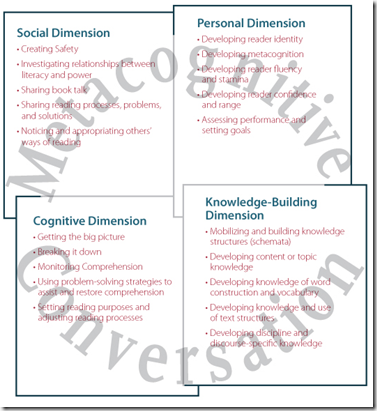
In my last post, I shared an article by Ed Week that highlighted the nonacademic skills needed for college and career success . The article brought me back to the framework for Reading Apprenticeship, an approach to adolescent literacy. The framework is posted to the right. When I was first introduced to the Reading Apprenticeship framework my initial thought was the social and personal dimensions were just like cotton candy…. looks good, tastes good, but not much substance. I have come to realize how very wrong I was. In fact, the personal and social dimensions are the very strength of the model. Look to the framework and ask yourself … Where do secondary teachers live? Where do students live? Most educators would say secondary teachers are focused on knowledge-building, while most say students value the social dimension over the others. It just is not realistic to think we will inspire deep content knowledge without valuing individual students and their need for soci...

Dispositions for Success

Today I was catching up on some reading and ran across an article in Ed Week entitled, Experts Begin to Identify Nonacademic Skills Key to Success . “[T]he biggest predictor of success is a student’s conscientiousness, as measured by such traits as dependability, perseverance through tasks, and work ethic. Agreeableness, including teamwork and emotional stability were the next-best predictors of college achievement, followed by variations on extroversion and openness to new experiences.” What caught my eye was not the actual article, although I did find that interesting, rather it was the reaction to the article in the comments section. Many of the comments were rather negative, defensive even. Some even stating it is only through Charters and other private education institutions that these skills can be emphasized. Others were critical indicating this is not the job of schools, rather parents and community members should take the lead. Why is it that so many of us think it ...

Wanted: Great Ideas

  Over the last few months I have posted research on boys and reading . Shared some ideas for engaging all students, but especially boys in reading. These ideas included podcasts and five big ideas of reading , leveraging technology as a means to active literacy with before, during and after reading strategies, and most recently digital book reports . Pennsylvania is fortunate to have PAIUnet, a private network that literally nearly all 500 school districts and IUs have access. It’s a safe network where students and teachers can collaborate, publish, share and interact. We currently have access to several services and products through Keystone Commons , Safari Montage , and VoiceThread . Note some of these services have a subscription fee, while others are at no charge. In thinking about promoting reading in boys, what other kinds of services and supports could we leverage in this private network for PA students and teachers? Some ideas already shared have been a digital...

Book Reports Go Digital

Kudos to Recorded Books for launching an innovative contest encouraging students to read. Their Digital Book Report Contest is promoting their new literature curriculum, Book Jams . According to the the Book Jam website a digital book report would look like this… “Have your students pick their favorite book or a book from your lesson plan and create a song, performance, or debate. Get creative and win! Use music, props, and costumes! But make sure that it covers the core standards. We’d love to see rap songs about grammar, interactive presentations highlighting setting and symbolism, plays about conflict starring Hester Prynne to Harry Potter, and whatever else you and your students dream up!” The contest is innovative and engaging. The entries are diverse and captivating. Students cleverly used pictures, audio, music, original music, costumes, props and much more…. Finalist are now posted. Be amazed! Visit the Contest site , create an account and give these kids the feedb...

Root Cause Stories

During a recent school improvement training we asked, “Why is the wild owl population in India decreasing?” After suspending disbelief that this question had anything to do with school improvement, the audience called out possibilities such as: Pollution Migration patterns Loss of habitat They seem plausible, but to pursue them would be folly as none of those would address the cause for the dwindling owl population. Unfortunately too often school improvement teams, in their sense of urgency to “fix” the problem ,  forget to study the problem and possible solutions. They forget that they likely need more data to confirm or deny any of their hypotheses. Time consuming work for sure, but better than the alternative… working on solutions that will have little to no effect on the issue. Victoria Burnhart in her article Multiple Measures indicates that Demographic and Achievement data are insufficient to identify root cause e.g. Number of owls this year compared to...

Before, During and After….

Image
We did an exciting program this summer in looking at the nexus of boys, reading pedagogy and the role of technology. The basic premise is if some students prefer more action based literacy activities, could technology fill that role? We came up with technology tools that could be used as Before, During and After reading strategies. All participants read the book, Diary of a Wimpy Kid, by Jeff Kinney as the back drop of looking at how reading pedagogy could be enhanced by technology tools. Before During After (focus retelling) Multi media text sets Blog Digital story telling   Wallwisher Movie Maker   Voicethread     Wordle     Glogster     Flip Note Studio   Teachers then embedded these technology to...

Hole in the Wall

Must watch video that looks at engagement, motivation and student learning. Presuming student capability. Click here to open up the video. Thanks to Michelle D. for sharing this. What do you think?

Part II: Aliteracy Vs. Illiteracy

Last week I summarized Kylene Beers research on the continuum of readers . At the end I asked some questions regarding instruction on each type of reader. Turns out Dr. Beers followed with another article detailing tips and techniques to working with aliterate students. “We must realize that whatever motivates an avid or dormant reader probably won’t motivate an uncommitted or unmotivated student. Motivating Readers (p. 112) reveals the same activities that encourage readers in fact discourages nonreaders, intimidating them and confirming negative feelings. The activities that uncommitted or unmotivated readers preferred were limited, but specific” (Beers, 1996, p.111). 1. Personal Choice – They want to choose their own books from a limited selection. They were wary of being overwhelmed with a large library. 2. Nonfiction – Many reluctant readers prefer nonfiction over fiction. 3. Illustrations – Pictures and illustrations were very important to these students. Time agai...

Aliteracy Vs. Illiteracy

Image
  Kylene Beers, as part of a research study, observed two 7th grade classrooms for one year. Through discussions regarding attitudes and habits as readers, she developed a typology of a reader. “It was easy to identify readers at both ends of the spectrum; they readily fit the academic and social descriptions others have provided. It was more difficult to classify the aliterate readers. In fact, I found grouping them under one term – aliterate – was inaccurate because because they gave different reasons for not reading. Understanding these reasons eventually led me to three distinct types of aliterate readers: Dormant, Uncommitted, and Unmotivated” (Beers, 1996, p. 31). I have been pondering this information for awhile. It makes me wonder who the students are in remedial classes. Are they illiterate or aliterate? How would we know or are we focuses exclusively on test scores? Are instructional strategies the same for each type of reader? Are there a disproportionate num...