Posts

Showing posts with the label literacy

Social Dimension

Image
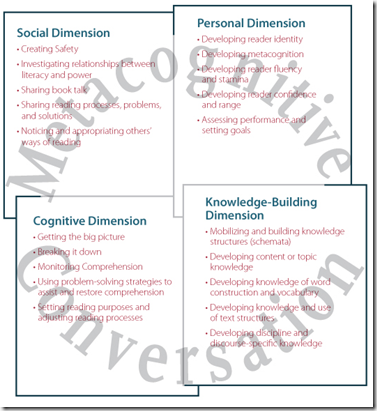
In my last post, I shared an article by Ed Week that highlighted the nonacademic skills needed for college and career success . The article brought me back to the framework for Reading Apprenticeship, an approach to adolescent literacy. The framework is posted to the right. When I was first introduced to the Reading Apprenticeship framework my initial thought was the social and personal dimensions were just like cotton candy…. looks good, tastes good, but not much substance. I have come to realize how very wrong I was. In fact, the personal and social dimensions are the very strength of the model. Look to the framework and ask yourself … Where do secondary teachers live? Where do students live? Most educators would say secondary teachers are focused on knowledge-building, while most say students value the social dimension over the others. It just is not realistic to think we will inspire deep content knowledge without valuing individual students and their need for soci...

Wanted: Great Ideas

  Over the last few months I have posted research on boys and reading . Shared some ideas for engaging all students, but especially boys in reading. These ideas included podcasts and five big ideas of reading , leveraging technology as a means to active literacy with before, during and after reading strategies, and most recently digital book reports . Pennsylvania is fortunate to have PAIUnet, a private network that literally nearly all 500 school districts and IUs have access. It’s a safe network where students and teachers can collaborate, publish, share and interact. We currently have access to several services and products through Keystone Commons , Safari Montage , and VoiceThread . Note some of these services have a subscription fee, while others are at no charge. In thinking about promoting reading in boys, what other kinds of services and supports could we leverage in this private network for PA students and teachers? Some ideas already shared have been a digital...

Book Reports Go Digital

Kudos to Recorded Books for launching an innovative contest encouraging students to read. Their Digital Book Report Contest is promoting their new literature curriculum, Book Jams . According to the the Book Jam website a digital book report would look like this… “Have your students pick their favorite book or a book from your lesson plan and create a song, performance, or debate. Get creative and win! Use music, props, and costumes! But make sure that it covers the core standards. We’d love to see rap songs about grammar, interactive presentations highlighting setting and symbolism, plays about conflict starring Hester Prynne to Harry Potter, and whatever else you and your students dream up!” The contest is innovative and engaging. The entries are diverse and captivating. Students cleverly used pictures, audio, music, original music, costumes, props and much more…. Finalist are now posted. Be amazed! Visit the Contest site , create an account and give these kids the feedb...

Part II: Aliteracy Vs. Illiteracy

Last week I summarized Kylene Beers research on the continuum of readers . At the end I asked some questions regarding instruction on each type of reader. Turns out Dr. Beers followed with another article detailing tips and techniques to working with aliterate students. “We must realize that whatever motivates an avid or dormant reader probably won’t motivate an uncommitted or unmotivated student. Motivating Readers (p. 112) reveals the same activities that encourage readers in fact discourages nonreaders, intimidating them and confirming negative feelings. The activities that uncommitted or unmotivated readers preferred were limited, but specific” (Beers, 1996, p.111). 1. Personal Choice – They want to choose their own books from a limited selection. They were wary of being overwhelmed with a large library. 2. Nonfiction – Many reluctant readers prefer nonfiction over fiction. 3. Illustrations – Pictures and illustrations were very important to these students. Time agai...

Aliteracy Vs. Illiteracy

Image
  Kylene Beers, as part of a research study, observed two 7th grade classrooms for one year. Through discussions regarding attitudes and habits as readers, she developed a typology of a reader. “It was easy to identify readers at both ends of the spectrum; they readily fit the academic and social descriptions others have provided. It was more difficult to classify the aliterate readers. In fact, I found grouping them under one term – aliterate – was inaccurate because because they gave different reasons for not reading. Understanding these reasons eventually led me to three distinct types of aliterate readers: Dormant, Uncommitted, and Unmotivated” (Beers, 1996, p. 31). I have been pondering this information for awhile. It makes me wonder who the students are in remedial classes. Are they illiterate or aliterate? How would we know or are we focuses exclusively on test scores? Are instructional strategies the same for each type of reader? Are there a disproportionate num...

Boys and Reading

Image
  The graph above shows an amazingly consistent pattern regarding the reading achievement of girls (top line) and boys (bottom line). While this graph highlights the longitudinal data of 13 year olds, the picture for 9 and 17 year olds looks remarkably the same. Basically girls out score boys and have for 30 years across all age groups according to the National Test of Educational Progress (NAEP.) Michael W. Smith & Jeff Wilhelm summarize the findings on boys and literacy in their book Reading Don’t Fix No Chevys (2002) pages 10&11 :   Achievement: Boys take longer to read than girls. Boys read less than girls. Girls tend to comprehend text significantly better than boys. Boys tend to do better with information retrieval & work-related literacy tasks than girls. Attitude: Boys generally provide a lower estimate of their reading abilities than girls do. Boys value reading as an activity less than girls do. Bo...

Reading Walkthrough Checklists

One of our educational consultants came across grade-level elementary reading checklists from the Florida Center for Reading Research, a nationally recognized leader in reading research. Scroll down to the bottom of the page to see the checklists.

The Future of Libraries

Scott McLeod at Dangerously Irrelevant posted 10 Questions About Books, Libraries, Librarians, and Schools . He asks some hard questions about how technology is changing the way information is shared and stored. I am avid bibliophile, yet most of my reading is an electronic format at this point, I am annoyed when I cannot purchase a book on my Kindle. I love libraries and book stores, but love information at my fingertips more. What does all this mean for the structure of current school libraries, information literacy and the jobs of librarians? It is easy to discount Mr. McLeod’s questions , to push them aside or maybe even be a little angry at some of his more provocative questions. However,its been my experience we shape the future or the future shapes us. Rather than be in denial or get angry, let’s take on his questions. We want 21st century learners, let’s not be afraid to talk about shaping 21st century schools. What a great strategic planning discussion! Check out his qu...

Reading Apprenticeship

I attended the Reading Apprenticeship Winter Conference and was asked to be a part of the panel discussion at the conclusion of the conference. Here's a preview of the key points of my presentation: Reading Apprenticeship (RA) is much more than content area literacy. If you are "doing" RA you are addressing Inclusion, 21st Century Skills, Principles of Effective Instruction, Higher Order Thinking Skills, Secondary Response-to-Intervention, Questioning, High School Reform, Differentiated Instruction, Adolescent Literacy and more. To ensure RA gets the time and resources it needs, it is wise to have RA permeate as many school planning documents as possible e.g strategic plan, school improvement, Special Education Plan, LRE Plan, Professional Education Plan, Induction Plan, etc.....

Podcasting and the Five Big Ideas of Reading

Image
My son is nine years old and has really benefited from using podcasting to improve his reading comprehension and motivation to read. The problem is that he only has access to podcasting at home. It's not that his school lacks resources, rather it has been that his teachers have trouble understanding how podcasting can be incorporated into reading instruction. In fairness to his teachers, my experience has been that the bells and whistles of podcasting are emphasized rather than podcasting as a specific curriculum integration tool. I started wondering how we might leverage podcasting to develop reading skills within all the five big ideas of reading. The National Reading Panel concluded that quality literacy instruction encompasses Five Big Ideas. Five Big Ideas of Reading Phonemic Awareness: The ability to hear and manipulate sounds in words. Alphabetic Principle: The ability to associate sounds with letters and use these sounds to form words.  Fluen...

On Their Way to 100% AYP

Image
For Shohola Elementary School , Delaware Valley School District , a 100% AYP is not an elusive dream, rather it is close to reality with a combined score of 90% proficiency for reading and 93% for math for grades 3 to 6. In addition, Shohola received top scores on PVAAS for both Growth and Achievement for 4th grade reading and math and 6th grade reading and math. Meaning their students are not entering school with exceptional abilities, rather specific curricular and instructional practices are contributing to student success. I sat down with James Purcell, Director of Elementary Education, to learn the secrets of their success. Their story begins with dissatisfaction with their Title I reading program. Their data indicated they were not moving their students. As Mr. Purcell said, "if you can't move the bottom group of students, you can't move your scores." They met with their numerous stakeholders, but it was the Title I reading specialists themselves that sugges...

Academic Vocabulary

Image
Most teachers would agree that vocabulary instruction is a critical part of instruction. It's fair to ask ourselves what passes for good vocabulary instruction? Is it copying words and their corresponding definitions from the board or overhead? Is it looking up definitions in a dictionary? Crossword puzzles? What about work searches? The fact of the matter is, that much of what passes for vocabulary instruction are actually lessons in handwriting, eye hand coordination, and copying words. Vocabulary instruction is really concept development. Students need to interact with words. It's rich and meaningful activities like word sorts, student-friendly descriptions, non-linguistic representations, and multiple opportunities to interact with the word through vocabulary games. These are meaningful routines that help make words stick.

Curriculum Framework

Curriculum Frameworks is one of the six circles. The PA Department of Education created committees of teachers and curriculum specialists throughout PA to create curriculum frameworks in literacy, math and social studies. The curriculum framework consists of Big Ideas, Concepts, and Competencies. Big Ideas are the the overarching key ideas of a subject. Big Ideas are larger constructs and likely require more than one year to achieve. Concepts and the knowledge skills to be mastered in a particular grade level. Competencies are what students must be able to do by grade level. The big question is if we already have standards and assessment anchors, why do we need curriculum frameworks? In order to answer that you have to think about what the standards and assessment anchors really offer us. Standards are written as a menagerie of big ideas, concepts and competencies for grades 3, 5, 8 and 11. Assessment Anchors are written for grades 3-8 and 11 based on the parameters of the PSSA. The Cu...