Posts

Showing posts with the label curriculum

Dispositions for Success

Today I was catching up on some reading and ran across an article in Ed Week entitled, Experts Begin to Identify Nonacademic Skills Key to Success . “[T]he biggest predictor of success is a student’s conscientiousness, as measured by such traits as dependability, perseverance through tasks, and work ethic. Agreeableness, including teamwork and emotional stability were the next-best predictors of college achievement, followed by variations on extroversion and openness to new experiences.” What caught my eye was not the actual article, although I did find that interesting, rather it was the reaction to the article in the comments section. Many of the comments were rather negative, defensive even. Some even stating it is only through Charters and other private education institutions that these skills can be emphasized. Others were critical indicating this is not the job of schools, rather parents and community members should take the lead. Why is it that so many of us think it ...

Great Curriculum Resource

I stumbled upon a veritable paradise for curriculum folks at the K – 12 Curriculum Development blog . The site is led by Steven Weber, Director of Secondary Instruction for Orange County Schools in Hillsborough, NC. I think the title sums up the intent of the blog … to offer tools, research, and insights into all things related to curriculum. Check it out and let us know what you think!

Purpose of Education

Image
Below is an excerpt I wrote for a college class. As a follow up, I need feedback from all of YOU to demonstrate the power of blogging! Please react to my post and comment on the purpose of education from your point of view.     Martin Luther King (1947) once said that education has two functions: utility and culture. He goes on to say that “It is intelligence plus character” that is the true purpose of education. I believe that dual purpose is still relevant today. We live in an increasingly complex, global society. Education must prepare students with the skills to live, work and thrive in this environment. This includes subject matter knowledge, but equally important will be skills such as communication, problem-solving, collaboration, information literacy, and character. Education must prepare students to be life-long learners in the truest sense of the term. Fewer and fewer unskilled labor jobs will exist. The future will depend on the ability of all individuals...

Growing Up Digital

I have been reading (on my Kindle) Don Tapscott’s (2009) Grown Up Digital: How the Next Generation Is Changing Your World . Tapscott urges educators to move from “broadcast learning to interactive learning.” Here’s a quote I liked summarizing his rationale: “Teachers are not a fountain of knowledge, the internet is.” What does curriculum and instruction look like in a classroom where most knowledge level questions can be answered with a simple Google search? 

Meeting the Needs of Diverse Learners

Image
All the school districts in my region and many others across Pennsylvania have access to Discovery Education , probably best known for streaming video. When I searched for streaming videos 116,458 results came up which can be further refined by grade level, subject area, type of media etc... Folks most often think of video clips or even full length videos and they would be right…. but there is much, much more. Discovery also has: Songs (466) – Multiplication raps, ABCs, Homophone Blues, Tornados & Hurricanes to name a few… Audio files (48) – speeches, historical events, and more Images (20,828) – historical events, historical figures, places, animals etc.. Writing prompts (603) – still pictures combined with a writing prompts historical people/events, careers & a large number for literary analysis. Prompts can be copied and/or edited to customize for teacher needs. Clip art (1184) –Most of the collection is for the elementary grades Sound effects (3...

More on the Four Day School Week

Image
Back in December I shared that Southern Columbia School District in Catawissa, PA intended to have a Four-Day School Week through January and February to save on heating and transportation costs. According to School Leader News the idea of a four-day school week is gaining momentum around the county . National Trends Select districts in about 17 states already have a four-day week with similar proposals being considered by the legislature in Florida, Georgia, Indiana, Maine, Missouri and Washington. The four-day school week was introduced in the 70's in response to the oil crisis and is now gaining fresh momentum in these troubling economic times. In order to meet state laws regarding instructional hours, most districts found they had to add just over one hour of instruction per day.   According to Associated Press (the source for this article) research indicates that districts save on transportation costs and can lead to increased attendance and teacher retention. In addi...

Long-term Planning Leads to Results

Image
Wilson H igh School, Wilson Area School District , is the only high school in the IU 20 region that made high growth for both math and reading. I had the opportunity to meet with John Martuscelli, Wilson High School Principal, and David Wright, Director of Curriculum & Instruction, to learn their strategies for success. The work began in 2005 and was formalized into a math plan in 2006 which revolved around curriculum alignment, increasing opportunities for learning mathematics, and placing ownership for student achievement onto the students. Curriculum Alignment The curriculum committee did not want to depend on electives to deliver the standards. Therefore, the curriculum needed to be written to ensure that ALL students had access to a rigorous sequence of math courses that delivered all core standards.   All General math courses were eliminated. All students, including IEP students, must take Algebra 1, Algebra II and Geometry. Multiple formats for learn...

Reading Apprenticeship

I attended the Reading Apprenticeship Winter Conference and was asked to be a part of the panel discussion at the conclusion of the conference. Here's a preview of the key points of my presentation: Reading Apprenticeship (RA) is much more than content area literacy. If you are "doing" RA you are addressing Inclusion, 21st Century Skills, Principles of Effective Instruction, Higher Order Thinking Skills, Secondary Response-to-Intervention, Questioning, High School Reform, Differentiated Instruction, Adolescent Literacy and more. To ensure RA gets the time and resources it needs, it is wise to have RA permeate as many school planning documents as possible e.g strategic plan, school improvement, Special Education Plan, LRE Plan, Professional Education Plan, Induction Plan, etc.....

On Their Way to 100% AYP

Image
For Shohola Elementary School , Delaware Valley School District , a 100% AYP is not an elusive dream, rather it is close to reality with a combined score of 90% proficiency for reading and 93% for math for grades 3 to 6. In addition, Shohola received top scores on PVAAS for both Growth and Achievement for 4th grade reading and math and 6th grade reading and math. Meaning their students are not entering school with exceptional abilities, rather specific curricular and instructional practices are contributing to student success. I sat down with James Purcell, Director of Elementary Education, to learn the secrets of their success. Their story begins with dissatisfaction with their Title I reading program. Their data indicated they were not moving their students. As Mr. Purcell said, "if you can't move the bottom group of students, you can't move your scores." They met with their numerous stakeholders, but it was the Title I reading specialists themselves that sugges...

Schools Close, But Learning Continues

According to Susan Patrick , President and CEO of International Association for K12 Online Learning , all secondary schools (grades 7-12) in Singapore close for one week each year, but students continue their education through online learning. "Singapore trains all of their teachers to teach online, using a learning management system and digital content.  All secondary school teachers and students use online learning and they have 100% e-learning in their schools every day.  In fact, to ensure all teachers and students are comfortable learning any time, any place, Singapore holds e-learning week once a year.   They physically shut schools down and the continuity of learning continues through the well-developed and continuous use of the e-learning delivery model that is used in the face-to-face classrooms, too" (email communication, January 8, 2008). e-Learning Week provides several opportunities. It forces all teachers to utilize technology tools an...

10,000 Hours to Success

Image
Malcolm Gladwell, bestselling author and staff writer for the New Yorker, has a magic number for success. In his latest book, Outliers: The Story of Success ,  Gladwell makes a compelling case for explaining success. Turns out factors such as innate ability do not factor into success as much as we might think. Turns out practice.... 10,000 hours of practice to be exact translates into success. From Bill Gates to Mozart to the Beatles and grandmaster chess champions, Gladwell uses the 10,000-Hour Rule again and again to explain their success. It's not that innate ability isn't a factor, it just isn't a determining factor. For a sneak peek at how Gladwell unravels his theory read the excerpt below: A research study comparing amateur and professional pianist "couldn't find any naturals that float to the top while practicing a fraction of the time their peers did. Nor did they find any grinds , people who worked harder than everyone else, but just didn't h...

Controversy Over Cursive

Image
Twenty years ago ---- eek that's how long it has been since I graduated from high school, cursive was a given in the curriculum. Teachers used it, students had to be able to read it and write it. I can remember copying copious notes from the board in cursive. A lot has changed in those two decades. I now reserve cursive for signing checks and other documents. I rarely find I need to read something in cursive, other than perhaps a name. Typing, however, has become an absolute necessity. How important is cursive? With all the content that has been added, not to mention accountability.... how valuable is it? Do we need to spend time as early as third grade on teaching cursive? What do you think? Photo from http://www.flickr.com/photos/ocherdraco/88217480/

Planning for Differentiation

Image
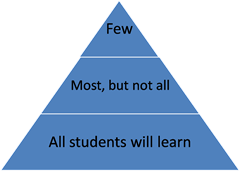
An article in the Washington Post, Schools Look At Providing More Time For Teachers caught my eye recently which looks at teacher planning time. As you might imagine, teachers feel they lack planning time.... and they may have a point. The amount of planning time has stayed constant while requirements for inclusion and accountability have increased. My question is do we design curriculum to address these challenges from the onset or do we expect teachers to plan lessons, adjust their instruction for a variety of diverse learners, grade assignments, connect with parents and other colleagues, make copies in a 40 minute planning period? Why not differentiate the curriculum from the beginning? The graphic to the left depicts the Curriculum Planning Pyramid (Schumm, Vaughn, & Leavell, 1994) which represents how curriculum might be organized to meet the needs of all learners. The base represents the most important concepts you want ALL STUDENTS to learn. The middle layer represents...

Four Day School Week

Southern Columbia School District in Catawissa, PA, which coincidentally is my alma mater, is moving to a four-day school week for January and February. The school will still meet the mandated 180 day requirement, but estimates it will save thousands in heating and fuel costs. Teachers will still be at work participating in professional development at the high school. The teacher contract already included these days as a requirement and according to sources all the district did was realign the calendar. Click here for the news article. The idea appeals to me on many levels. As a professional developer having a week in between follow up sessions is ideal. I can imagine the amount of support and momentum that could be achieved with sustained support over an eight week period. As a parent, I think it would be a great time to work on larger assignments and projects that kids receive as homework not to mention the benefit of not having kids waiting for the bus in the cold. Child care co...

Technology Intensive Courses

The current approach to educational technology integration is to train ALL teachers in the use of web 2.0 tools and HOPE teachers choose to infuse these tools into instruction. We train and hope with no guarantee that all students would benefit. I am wondering if our approach is the most effective and efficient it could be? Instead of focusing on all teachers, I am wondering if we shouldn't focus our energies on a FEW teachers in efforts that would benefit ALL students. I am suggesting schools create Technology Intensive Courses. Imagine if ALL students had access to a technology intensive course each year they were in high school. It would be great if all teachers and courses integrated technology tools, but shouldn't we at least ensure that all students have access to at least one? My thoughts are that curriculum committees would identify at least four courses that would be rewritten to include 21st century skills, not as an add on, but as genuine concepts, tools and ...

Curriculum Pacing Guides

If you haven't read the latest issue of Ed. Leadership yet, let me give you another reason to pick it up. The issue features a two-page article summarizing the research on Pacing Guides. The article indicates that pacing guides are not inherently bad, but too often the manner in which they are used results in narrowing the curriculum, fragmenting knowledge into test related pieces, and increasing teacher-centered instruction. Most guides do not address student reasoning and teachers rarely deviate from the guides. In contrast, Japanese pacing guides describe student solutions to problems and describe how teachers can build on student thinking during instruction. Recommendations - Guides Should: Emphasize curriculum guidance, rather than prescriptive pacing. Focus on central ideas. Provide links to exemplary curriculum materials, lessons, and instructional strategies. I would further recommend that administrators consider how the prescriptive use of pacing guides impedes implement...

Curriki

Image
Curricula plus wiki = Curriki Another great find from Joyce Valenza and her amazing blog, NeverEnding Search, which is always filled with great resources and/or ideas. What is Curriki ? It is a very sophisticated wiki for teachers to upload work, share resources and create online learning communities around specific topics, even Career and Technical Education. Not only can you share work, but you can nominate work to be reviewed by master teachers. Resources are ranked as a 1 - Basic , needs a substantial amount of clean up or expansion to be used for teaching and learning, 2 - Good , can be used immediately, but may need some refinement, or 3 - Exemplary . Curriki has over 45,000 members at the time of this posting, educators from all around the world sharing their best work. We discussed using a wiki for teachers to share work regionally, but Curriki takes the idea to a whole new level.... they're sharing globally! Ways to use Curriki: Find resources - Over 18,000 available Co...

A Head of the Curve

This summer's Governor's Institute unveiled the Standards Aligned System (SAS) and the curriculum framework in math and literacy. Math is not my area of strength, but I decided to attend the math sessions and I was glad I did. I learned a lot about mathematics and found several exciting connections. First, the week long training provided by the Governor's Institute entitled, Developing Mathematical Ideas (DMI), is exactly the same training we have been offering at the IU for the last several years. We are ahead of the curve and are well poised to enhance our existing training with the Mathematics Curriculum Framework created by PDE. Second, the facilitators began each module with mental math. I was struck how closely the process paralleled a Reading Process Analysis in Reading Apprenticeship. The mental math activity slowed down thinking and helped to surface mathematical understanding as well as strategies for solving problems. I have long wondered how to make content...

Curriculum Framework

Curriculum Frameworks is one of the six circles. The PA Department of Education created committees of teachers and curriculum specialists throughout PA to create curriculum frameworks in literacy, math and social studies. The curriculum framework consists of Big Ideas, Concepts, and Competencies. Big Ideas are the the overarching key ideas of a subject. Big Ideas are larger constructs and likely require more than one year to achieve. Concepts and the knowledge skills to be mastered in a particular grade level. Competencies are what students must be able to do by grade level. The big question is if we already have standards and assessment anchors, why do we need curriculum frameworks? In order to answer that you have to think about what the standards and assessment anchors really offer us. Standards are written as a menagerie of big ideas, concepts and competencies for grades 3, 5, 8 and 11. Assessment Anchors are written for grades 3-8 and 11 based on the parameters of the PSSA. The Cu...