Posts

Showing posts with the label resources

Resources for Staff Development

A blog post by Elliot Seif from ASCD’s the Edge caught my eye today. The author lists a variety of journal articles that support staff development for a variety of purposes e.g. assessment, change process, curriculum, instructional practices etc.…. The articles listed can be found in the ASCD archives for members. Journal articles become a resource for studying and reflecting on our profession, developing teacher background knowledge and nurturing life learning. If we want students that are life long learners, we need teachers that are life long learners. Utilize your membership by diving into a few of the suggested articles and share/discuss them with colleagues.

Every Educator Should Watch

  Over the break, I watched, Waiting for “Superman,” a documentary analyzing the failures of the American public education system. The film is a tangle of facts, figures and emotional stories of children and their families. It’s bold, matter of fact, and compelling. Do they have it right? Do the facts have merit? I am urging each and every educator to watch this film and draw their own conclusions because policy-makers and community members certainly are…..

Before, During and After….

Image
We did an exciting program this summer in looking at the nexus of boys, reading pedagogy and the role of technology. The basic premise is if some students prefer more action based literacy activities, could technology fill that role? We came up with technology tools that could be used as Before, During and After reading strategies. All participants read the book, Diary of a Wimpy Kid, by Jeff Kinney as the back drop of looking at how reading pedagogy could be enhanced by technology tools. Before During After (focus retelling) Multi media text sets Blog Digital story telling   Wallwisher Movie Maker   Voicethread     Wordle     Glogster     Flip Note Studio   Teachers then embedded these technology to...

Reading Walkthrough Checklists

One of our educational consultants came across grade-level elementary reading checklists from the Florida Center for Reading Research, a nationally recognized leader in reading research. Scroll down to the bottom of the page to see the checklists.

New Resources

Image
      A couple of key organizations have recently started some wonderful blogs. Expand your personal learning network with these great resources. Change.org started a blog in January. They hit on a range of topics including an interview with Thomas Friedman, Charter Schools, Writing, Class Size, Teacher Unions.... No educational topic appears off limits. Click here to check it out!  HOPE Foundation , an organization dedicated to "supporting educational leaders over time in creating school cultures where failure is not an option for any student," debuted their What's Working in Schools Blog in February. Topics include professional development, teacher issues, policy, assessment and much more. Click here to view the What's Working in schools Blog.   National Staff Development Council (NSDC), who's purpose is to ensure " every educator engages in effective professional learning every day so every student achieves....

Podcasting and the Five Big Ideas of Reading

Image
My son is nine years old and has really benefited from using podcasting to improve his reading comprehension and motivation to read. The problem is that he only has access to podcasting at home. It's not that his school lacks resources, rather it has been that his teachers have trouble understanding how podcasting can be incorporated into reading instruction. In fairness to his teachers, my experience has been that the bells and whistles of podcasting are emphasized rather than podcasting as a specific curriculum integration tool. I started wondering how we might leverage podcasting to develop reading skills within all the five big ideas of reading. The National Reading Panel concluded that quality literacy instruction encompasses Five Big Ideas. Five Big Ideas of Reading Phonemic Awareness: The ability to hear and manipulate sounds in words. Alphabetic Principle: The ability to associate sounds with letters and use these sounds to form words.  Fluen...

Planning for Success

Image
Our intermediate unit hosted a joint meeting between our Special Education and Curriculum Advisory Councils on January 9, 2009.  We gave groups of administrators planning documents required by the PA Department of Education such as Strategic Plan, Professional Education Plan, Induction Plan, Technology Plan, Special Education Plan, School Improvement Plan...etc... These plans were from real schools in PA. We asked the teams to count up the number of initiatives listed across the plans and to evaluate the alignment between the plans. Their analysis was telling. While some plans had alignment, others did not. One group counted 87 initiatives within the document. This did not include any grants the district had. With scare resources such as time, money and personnel... can schools realistically achieve 87 goals? What about 50? What about 20? Myself, I think the answer lies closer to three or four. There are plenty of reasons why their is so much misalignment in plans.... multi...

National Staff Development Council - Free Trial Membership

Image
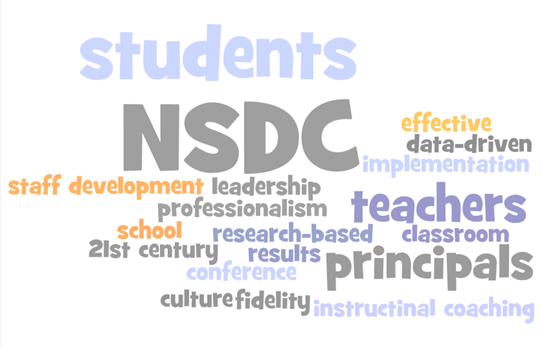
The National Staff Development Council (NSDC) is an organization dedicated to sharing the principles of effective, results-driven professional development. There is a science to staff development and NSDC promotes the practices that result in student achievement. For a limited time, NSDC is offering a trial membership. Since change happens at the school level, a special invitation is extended to building principals who want resources to improve the implementation of staff development initiatives. Click here for details on obtaining a trial membership.

Curse of Knowledge

Made to Stick by Chip and Dan Heath is a fantastic book for anyone that wants to know how to get others to embrace their ideas...people like students, teachers, administrators, parents... board members.... The authors contend that the Curse of Knowledge is a major barrier to getting our ideas to stick. In fact they refer to the Curse of Knowledge as a villain, undermining all efforts to share ideas. Why? Great Question.... glad you asked! "Novices perceive concrete details as concrete details. Experts perceive concrete details as symbols of patterns and insights that they have learned through years of experience. And, because they are capable of seeing at a higher level of insight, they naturally want to talk on a higher level. They want to talk about the chess strategies, not about the bishops moving diagonally." (Heath & Heath, 2007, p. 114) The Curse of Knowledge creeps up on us. It doesn't mean we dumb down the information. Rather we need to identi...

Differentiated Instruction: Making Sure We Get it Right!

Image
I spent the day (with about 200 other educators) learning about differentiated instruction with Dr. Carol Ann Tomlinson. I was struck by the wonderful way Dr. Tomlinson weaves information with stories, case studies, and clarification. She facilitated the workshop as if she were a student of DI, instead of a national/international leader in the topic. A defining moment for me during the workshop was a discussion about the mindset of differentiation. Dr. Tomlinson shared that without a believe that it is possible for students to do better than they ever had before, without hope or anticipation of what could happen in the classroom for kids.... there is no foundation for differentiating instruction. In other words, optimism is the energy that propels differentiation. Without optimism there is no purpose or fuel for differentiation to grow. Reflection: Does our school demonstrate a "do whatever it takes attitude?" Do student strengths dominate the conversation? Do we make effort...

Instructional Coaching: Maximizing Results

The literature on professional development is absolutely clear. Workshops alone yield 5-10% rate of implementation. However, training reinforced by instructional coaches yields about 85% rate of implementation. How do we get the greatest impact from coaching, especially if teachers in the greatest need avoid working with the coach? To address this schools are following the lead of the Boston Collaborative Coaching Model. The Boston Model is developed around the need for all teachers to work with the instructional coach, not just volunteers. All teachers are required to work with the coach. Small co-hort groups are formed every six weeks and the coach works intensely with the small group. Boyertown School District borrowed the basic structure from Boston, but focused their coaching staff even more strategically on specific grade-levels for 10 week sessions. Boyertown has two elementary literacy coaches to serve seven elementary schools. Their three-plan addresses their efforts to make t...

Instructional Coaching - Resources

My good friend, Sue Kinney, Assistant Superintendent for Professional Development at Boyertown School District, shared a few wonderful instructional coaching resources with our Reading Advisory Council today. Prior to Boyertown, Sue was the Director of the PA Coaching Initiative. In other words, she knows her stuff. Sue shared some of her favorite coaching resources and I would like to pass them along: Instructional Coaching: A Partnership Approach to Improving Instruction by Jim Knight Coaching: Evoking Excellence in Others by James Flahery Community: A Structure of Belonging by Peter Block Content Focused Coaching: Transforming Math Lessons by Lucy West & Fritz Straub Taking the Lead : New Roles for School Based Coaches by Joellen Killion & Cindy Harrison Quality Teaching in an Era of Coaching by Stephen Barkley (Great intro to coaching) Differentiated Literacy Coaching: Scaffolding for Student and Teachers Success by Mary Katherine Moran Resources on the We...

Curriki

Image
Curricula plus wiki = Curriki Another great find from Joyce Valenza and her amazing blog, NeverEnding Search, which is always filled with great resources and/or ideas. What is Curriki ? It is a very sophisticated wiki for teachers to upload work, share resources and create online learning communities around specific topics, even Career and Technical Education. Not only can you share work, but you can nominate work to be reviewed by master teachers. Resources are ranked as a 1 - Basic , needs a substantial amount of clean up or expansion to be used for teaching and learning, 2 - Good , can be used immediately, but may need some refinement, or 3 - Exemplary . Curriki has over 45,000 members at the time of this posting, educators from all around the world sharing their best work. We discussed using a wiki for teachers to share work regionally, but Curriki takes the idea to a whole new level.... they're sharing globally! Ways to use Curriki: Find resources - Over 18,000 available Co...