Posts

Showing posts with the label relationships

Relationships and Technology

We are rapidly moving forward with a vision to augment our face to face professional learning opportunities for teachers and administrators. The goal is to provide learning opportunities in multiple formats including podcasts, webinars, videoconferencing, multimedia videos, etc… Our staff has been receptive, but there is a reluctance, maybe it is a sense of loss. Hord & Hall indicate grief is often mistaken for resistance. Working alone at your computer to facilitate a webinar or podcast can seem sterile – no immediate feedback, no eye contact or body language to help you gauge audience reaction.  It has given me pause to think about the role of technology and whether or not it is taking away from relationship building which is essential to our role as educational consultants at a regional service agency. As I was contemplating, I received a few emails in response to a webinar I facilitated: Reactions from participants following webinar 3 “On a personal note, I must ...

Join Us

Life has been pretty exciting lately, hence my blogging absence. My husband and I, in our infinite wisdom, moved mid school year. Just all kinds of fun with our two children and both us working in education! In addition, I added just a few job responsibilities. I am fortunate to be working with the Strategic Literacy Initiative, part of WestEd, a regional research lab, to coordinate Pennsylvania’s effort with implementing Reading Apprenticeship, an instructional framework to address content area literacy. Part of my efforts include contributing to their blog. Check out my new post, Report from Winter Conference: Reading Apprenticeship for Students with a Range of Needs . In the post, I share suggestions and examples regarding overcoming the challenging literacy needs that students sometimes bring to the high school level. What do you think? Can these ideas work?

Having a Voice

Image
I recently had the great misfortune to contract tonsillitis. Out of the myriad of unpleasant symptoms, the one that was the most difficult was loosing my voice. It was frustrating not to be heard. There were a few situations, especially with larger groups of people, when I started to withdraw from the conversation. It was just too much effort. This experience made me appreciate the value of Reading Apprenticeship, an approach to secondary literacy through the Strategic Literacy Initiative at WestEd. The Reading Apprenticeship framework focuses on students developing, expanding and building the confidence in their voice in discipline specific ways. In a traditional secondary classroom, it is not unusual for the main modality of learning to be lecture. Students sit, listen and regurgitate on demand. The teachers do most of the work and students are peripheral to the learning process. In converse, Reading Apprenticeship classrooms have students at their center. Students a...

Luau as a Metaphor for School Improvement

Image
The luau, once called the aha aina, was an event that was designed to unite the participants and foster good will, thanks and praise. The purpose of the luau could have been to celebrate accomplishments, honor heroes or gods, or commemorate important events. While some ancient foods represented strength or virility, other foods might symbolize virtues or goals the participants hoped to achieve (from To-Hawaii.com) A luau, in other words, is all about reflection. What is going well? What are the next steps? This is exactly what our school improvement teams did last week. They reflected on the level of implementation of their plan and the level of effectiveness. Participants spent the morning going through their plans goal by goal – looking back toward accomplishments and looking forward to next steps. We over-laid these discussions with information on managing and effectively facilitating change. We read Implications for School Leaders Facilitating Change , which is from H...

People, Not Purchase Orders

Administrators can and should be problem solvers. Unfortunately, the problems of schools are complex and not easily solved. In my experience with schools in improvement, this reality brings out one of three reactions: A) Paralysis – the problems of schools are so big, they cannot be solved. This generally involves some type of blame – It’s the assessment, it’s the parents, it’s the administrators, it’ the students – they are not motivated. B) Purchase – what can we buy to “fix” a problem. 65% of student achievement rests with the teacher – wish I could cite exactly where I got that from, alas it is a research conclusion that I picked up somewhere… The point is that despite all challenges to the contrary - It’s the rare school that understands the magic elixir is people! Savvy people, collaborating to find the root cause of a concern. People, thoughtfully researching, not shopping in a catalog, hiring speakers, or checking items off a list. People, creating a common language of ...

Making Learning Irresistible

  Dr. Tim Tyson , former principal of Mabry Middle School in Cobb County Georgia, led his staff on a quest to Make learning irresistible. A quick look at the former website convinces me they were on their way of achieving their their goal with a web presence that is virtually unmatched. It’s not that Mabry had a great website, but that they effectively used their website to further their mission and vision!   We talk about sharing examples of high quality student work. Their website showcases exemplary student work. Check out their Film Festival to see examples of student work or go to Podcast Central and see/hear about the successes of their students. We talk about partnering with parents. Staff blogs share homework and classroom happenings. The parent section has its own blog filled with relevant information concerning everything from student council minutes to immunization shots and year book sales. A portal for grades, attendance and discipline was also...

Students as Partners in Reform

Image
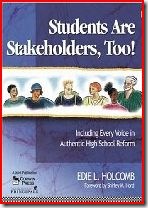
While I had the flu, I picked up Edie Holcomb’s book, Students Are Stakeholders, Too .  It combines research on high school reform with practical strategies for engaging students. The book is presented as a case study, based on a composite of the man y schools she has worked with as a consultant.  The author contends that “Students can be visionaries, advocates, and change agents--- when given the permission, expectation and some guidance” (Holcomb, 2007, p. 7). I doubt high school reform will ever be simple, but imagine if students as well as staff were helping to craft and carry out a school improvement plan! CONNECTIONS: As we looked at all the AYP Success stories from last school year (schools with high growth or high growth/high achievement) the single thing that stood out from all the school stories was a focus on RELATIONSHIPS!

Fierce Conversations

Image
Fierce Conversations by Susan Scott was the featured at our administrative book club this year. True to its title the book boldly described the need and the process for having critical conversations both at home and the work place. The book resonates with sound, practical advice. For a taste of the author’s edgy wisdom read on: “I don’t know about you, but I have not yet witnessed a spontaneous recovery from incompetence” (p. 60). “As a leader, you get what you tolerate” (p. 60). “What are you pretending not to know” (p. 70). “Sometimes we put so many pillows around a message that the message gets lost altogether” (p. 144). “Identify your contribution to the problem” (p. 151). Stay tuned as we apply Principle 1: Master the Courage to Interrogate Reality to school improvement. Scott, S. (2003). Fierce conversations: Achieving success at work and in life one conversation at a time. New York: Berkley Book.

Teacher/Student Mentoring

As I mentioned in an earlier post , Wilson High School, Wilson Area School District , is the only high school in the IU 20 region that made high growth for both math and reading. Here is Part II of their story: In 2007-08 the district created a Teacher/Student Mentoring Program. Each staff member including the principal, assistant principal, central office personnel including the superintendent mentored a group of 10 to 15 students throughout the school year. The assistant principal scheduled 6-8 meetings throughout the school year. The assistant principal also planned the sessions, almost scripted them to support teachers in this new role. Activities included meeting with each student individually to review their 4Sight scores and discussing the impact on students. For example a 10th grade student might have already completed Algebra, but 4Sight indicates some weaknesses. The mentor points out resources the student has available including PSSA Study Island, Math Labs, and Tutorin...

Relationships Lead to Results

Image
Northeast Middle School , Bethlehem Area School District , serves 835 students in grades 6 through 8. The student population is very diverse including over 50% who are Black or Hispanic. The school has many challenges including 61% poverty rate and 18.4% special education rate. In 2004, the school did not make AYP in several categories including the IEP subgroup and received a Warning Status. the following year brought School Improvement I. The work of the administrators, teachers and students has paid off. This year the school is completely off school improvement...having Made Progress for two consecutive years. In addition, Northeast MS made the IU 20 list of schools that have demonstrated the highest level of academic growth during the 2007-08 school year based on their PVAAS data three times..... 8th grade reading and math and 6th grade math. I sat down with Assistant Principal, Leigh Rusnak, to learn the secret to their success and the answer might surprise you.... RELATIONSHIPS!...

10,000 Hours to Success

Image
Malcolm Gladwell, bestselling author and staff writer for the New Yorker, has a magic number for success. In his latest book, Outliers: The Story of Success ,  Gladwell makes a compelling case for explaining success. Turns out factors such as innate ability do not factor into success as much as we might think. Turns out practice.... 10,000 hours of practice to be exact translates into success. From Bill Gates to Mozart to the Beatles and grandmaster chess champions, Gladwell uses the 10,000-Hour Rule again and again to explain their success. It's not that innate ability isn't a factor, it just isn't a determining factor. For a sneak peek at how Gladwell unravels his theory read the excerpt below: A research study comparing amateur and professional pianist "couldn't find any naturals that float to the top while practicing a fraction of the time their peers did. Nor did they find any grinds , people who worked harder than everyone else, but just didn't h...

Facebook: A Learning Tool For Teachers

Back in the fall I posted, Who's On Your Network , which discussed Will Richardson's article in Education Leadership entitled, Footprints in the Digital Age .   One of his recommendations was to join Facebook and to be perfectly honest... I didn't get it. What could I learn as an educator from Facebook?  As luck would have it, my husband's family is very active with Facebook, with Will's urging and their availability I decided to take the plunge. I have to say I am impressed. I have reconnected with family members, friends from high school and college, and colleagues from previous positions. With Facebook the past and present intersect, letting me in seconds catch up with friends and family. As an educator, Facebook gives me insight into the why and how students use social networking tools. In fact, I can see why students crave these tools. When you consider that building positive relationships is the corner stone of school improvement, how can we not investig...

Amplifying Student Voice

"To improve student achievement, it makes sense to go straight to the source---- students." This is a quote from an article in the November 2008 issue of Educational Leadership entitled, Amplifying Student Voice. The author, Dana Mitra summarizes the strong research base which strongly suggests that if we want reform to take hold we should involve students. These efforts can improve teachers' classroom practice, student-teacher relationships, students' agency, and sense of membership in the school. The article gives examples of student leadership which range from sharing opinions and thoughts to collaboration with adults to solve problems. In rare cases, students assume leadership roles to promote innovation. If you haven't already check out the Student Advisory Council post as another example of including the positive energy of students in the change process. Benefits of Including Student Voice: Gain new insights into problems Strengthen rela...

Student Advisory Council

Image
Law of Leadership: A successful team with 100 members has 100 leaders. -Lance Secretan Students are the largest stakeholder group a school has , but they are often overlooked source of information, energy and momentum for improvement efforts. I was intrigued when I heard East Stroudsburg Area School District (ESASD) had a Student Advisory Council in each high school that the superintendent and high school principal met with personally 3 - 4 times a year. Dr. Rachael Heath, Superintendent of ESASD, started the Advisory group when she came to the district four years ago. She is expanding the council to both intermediate schools this year and I can see why! Here's a summary of the meeting to give you a flavor of student interests and insights : A diverse mix of 20-25 students assembled in the school library. They opened the meeting with Old Business..... School Safety, Bathrooms, buses and the Cafeteria. The first two items were quick. Students indicated they felt safe and the bathr...