Posts

Showing posts with the label leadership

Inquiry

Image
According to wikipedia, negative space is defined, in art, as “the space around and between the subject(s) of an image. Negative space may be most evident when the space around a subject, and not the subject itself, forms an interesting or artistically relevant shape, and such space is occasionally used to artistic effect as the "real" subject of an image. The use of negative space is a key element of artistic composition .” In other words the absence of color can be very powerful. This seems like a good analogy for the power of the inquiry process. In other words, as facilitators we do not need to color every question or comment with our own experience, thoughts or expertise. There is wisdom in saying or telling less. We can use our content knowledge to ask deep questions and solicit wisdom from our participants. This will ultimately have more impact on our audience because they can reflect and internalize information more efficiently. It is a difficult balance. I kno...

Every Educator Should Watch

  Over the break, I watched, Waiting for “Superman,” a documentary analyzing the failures of the American public education system. The film is a tangle of facts, figures and emotional stories of children and their families. It’s bold, matter of fact, and compelling. Do they have it right? Do the facts have merit? I am urging each and every educator to watch this film and draw their own conclusions because policy-makers and community members certainly are…..

Join Us

Life has been pretty exciting lately, hence my blogging absence. My husband and I, in our infinite wisdom, moved mid school year. Just all kinds of fun with our two children and both us working in education! In addition, I added just a few job responsibilities. I am fortunate to be working with the Strategic Literacy Initiative, part of WestEd, a regional research lab, to coordinate Pennsylvania’s effort with implementing Reading Apprenticeship, an instructional framework to address content area literacy. Part of my efforts include contributing to their blog. Check out my new post, Report from Winter Conference: Reading Apprenticeship for Students with a Range of Needs . In the post, I share suggestions and examples regarding overcoming the challenging literacy needs that students sometimes bring to the high school level. What do you think? Can these ideas work?

Leadership is Essential

A good friend and colleague, Greg Llewellyn, recently came to my Curriculum Council Meeting to discuss strategies for effective implementation of initiatives. Greg shared his experience with school systems that have implemented district-wide initiatives successfully. He recommended districts consider a district-wide leadership team consisting of leadership at all levels whom meet frequently. This system helps to create a coherent understanding and common language regarding the initiative and the goal. It also helps with implementation issues that often develop regarding policy and procedures. These can best be acknowledged and addressed through a district leadership team. District leaders shared that this format was highly successful and kept potential “rogues” from going off on their own. The Caveat: Attendance at the leadership team was non-negotiable! For this district leadership team to work, all stakeholders must be present at critical decision points. Therefore, if all ...

Law of Initiative Fatigue

  In his new book, Transforming Professional Development into Student Results , Doug Reeves makes a case for severely limiting the number of initiatives a school or district pursues. “Education leaders have three essential resources: time, money, and emotional energy. Time is fixed. Financial resources are typically fixed, and in the present economy, diminishing. Emotional energy is variable.” “The Law of Initiative Fatigue states that when the number of initiatives increases while time, resources and emotional energy are constant, then each new initiative, no matter how well conceived or well intentioned – will receive fewer minutes, dollars and ounces of emotional energy than its predecessors.” Reader Challenge: Take a blank sheet of paper and write down every initiative in your school. Reply via comment and let us know how many initiatives you have and your thoughts about the Law of Initiative Fatigue.

Luau as a Metaphor for School Improvement

Image
The luau, once called the aha aina, was an event that was designed to unite the participants and foster good will, thanks and praise. The purpose of the luau could have been to celebrate accomplishments, honor heroes or gods, or commemorate important events. While some ancient foods represented strength or virility, other foods might symbolize virtues or goals the participants hoped to achieve (from To-Hawaii.com) A luau, in other words, is all about reflection. What is going well? What are the next steps? This is exactly what our school improvement teams did last week. They reflected on the level of implementation of their plan and the level of effectiveness. Participants spent the morning going through their plans goal by goal – looking back toward accomplishments and looking forward to next steps. We over-laid these discussions with information on managing and effectively facilitating change. We read Implications for School Leaders Facilitating Change , which is from H...

Students as Partners in Reform

Image
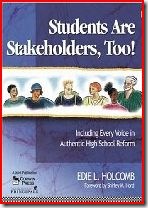
While I had the flu, I picked up Edie Holcomb’s book, Students Are Stakeholders, Too .  It combines research on high school reform with practical strategies for engaging students. The book is presented as a case study, based on a composite of the man y schools she has worked with as a consultant.  The author contends that “Students can be visionaries, advocates, and change agents--- when given the permission, expectation and some guidance” (Holcomb, 2007, p. 7). I doubt high school reform will ever be simple, but imagine if students as well as staff were helping to craft and carry out a school improvement plan! CONNECTIONS: As we looked at all the AYP Success stories from last school year (schools with high growth or high growth/high achievement) the single thing that stood out from all the school stories was a focus on RELATIONSHIPS!

Principle 1: Master the Courage to Interrogate Reality

This is the follow up to the Fierce Conversations post. I left the book club thinking how we could leverage Principle 1: Master the Courage to Interrogate Reality for school improvement. When we work with school improvement teams we see a nearly universal response. High school says if only the middle school had done its job, and the middle school says kids are not coming prepared. Other favorites include lack of motivation, students moving into the district, or it’s the parents. Let’s Interrogate Reality: When data is the foundation, we often see a different trend. High elementary scores, down slightly at middle school, then a sharp decrease at high school. NAEP data suggest the lower grades are beginning to close the achievement gap, while the gap is widening at the high school level. So in the words of Fierce Conversations author, Susan Scott, “What are we pretending not to know?” “What is our (administrators and teachers) contribution to the problem?” When will we b...

Fierce Conversations

Image
Fierce Conversations by Susan Scott was the featured at our administrative book club this year. True to its title the book boldly described the need and the process for having critical conversations both at home and the work place. The book resonates with sound, practical advice. For a taste of the author’s edgy wisdom read on: “I don’t know about you, but I have not yet witnessed a spontaneous recovery from incompetence” (p. 60). “As a leader, you get what you tolerate” (p. 60). “What are you pretending not to know” (p. 70). “Sometimes we put so many pillows around a message that the message gets lost altogether” (p. 144). “Identify your contribution to the problem” (p. 151). Stay tuned as we apply Principle 1: Master the Courage to Interrogate Reality to school improvement. Scott, S. (2003). Fierce conversations: Achieving success at work and in life one conversation at a time. New York: Berkley Book.

Stopping to Celebrate Public Education

Image
  Our annual Excellence in Education dinner recognized educators, schools, and community entities for outstanding work in the field of public education through the implementation of a program or service. These recognized programs received the Crystal Award for Excellence in Education. Each award winner had an opportunity to describe their program and talk about the impact it had on students. Winners ranged from a Health Related Technology program at a Career Center that serves the community through an adult daycare program to a character education program for elementary students and everything in between. The common thread of relationships seemed to connect all the programs. Retired individuals connecting to middle school students, teachers connecting to digital age of their students, students connecting to their parents, students connecting to the community etc... I left the event wondering whether we really understand school improvement. Is it about more math and reading ...

Effective Professional Development

Image
The February issue of Educational Leadership provides a summary of research on professional learning entitled, Teacher Learning: What Matters? by Linda Darling-Hammond & Nikole Richardson. The article is filled with great suggestions for effective professional development. The one that struck me the most was the following: "Professional development lasting 14 or fewer hours showed no effects on learning. The largest effects were for programs offering 30-100 hours spread out over 6-12 months." In other words the basis of effective staff development is ideally 30 or more hours of training on a single topic spread out over 6 to 12 month period. Reflection: How does your school or district compare to this research-based best practice?   Darling-Hammond, L. & N. Richardson. (February 2009). Teacher learning: What matters? Educational Leadership , Vol. 66(5), p. 46-53. Photo courtesy of CIU 20 Summer Administrative Workshop August 2006.

My Personal Organizer

Image
              A colleague recently expressed interest in Twitter and other web 2.0 tools, but dismissed them because she didn't have time. I agreed. She did not have time to go to multiple websites and get the latest updates. I can't think of an administrator that does have time. iGoogle is a personalized web page and  is a one stop organizer for me.   It allows me to add news, photos, weather, and much more from across the web. At a glance I can check my personal email, which I use to access a lot of the web 2.0 tools, Twitter, and the various blogs I read through Google Reader. In other words, iGoogle does the work for me... pulling and organizing all the latest updates into one convenient location. For me the key is using Gmail for my personal email. When I check my email, I manage to check everything else too. How do you keep organized? Any recommendations for working/accessing information at a glance?

Leading for Learning

This past Monday I visited East Stroudsburg North High School. Steve Zall, principal, hosted a group of administrators from a neighboring school district and myself to showcase his building's instructional walk-through process. As I listened to Steve share his experience and hospitality with us, I was struck by two things. First, instructional walk-throughs are not about teachers or teaching. They are about leading and leadership. Secondly, the term instructional leader is really not an accurate term, rather what we need in schools are learning leaders. To pay attention to instruction is not sufficient. We need leaders who are not content to simply schedule professional development and assume its implementation. We need leaders like Steve, who walk with a high degree of frequency from classroom to classroom looking for evidence of implementation. We need leaders that will learn along side their teachers, participate in staff development and be able to recognize implementation ...

Teacher/Student Mentoring

As I mentioned in an earlier post , Wilson High School, Wilson Area School District , is the only high school in the IU 20 region that made high growth for both math and reading. Here is Part II of their story: In 2007-08 the district created a Teacher/Student Mentoring Program. Each staff member including the principal, assistant principal, central office personnel including the superintendent mentored a group of 10 to 15 students throughout the school year. The assistant principal scheduled 6-8 meetings throughout the school year. The assistant principal also planned the sessions, almost scripted them to support teachers in this new role. Activities included meeting with each student individually to review their 4Sight scores and discussing the impact on students. For example a 10th grade student might have already completed Algebra, but 4Sight indicates some weaknesses. The mentor points out resources the student has available including PSSA Study Island, Math Labs, and Tutorin...

Relationships Lead to Results

Image
Northeast Middle School , Bethlehem Area School District , serves 835 students in grades 6 through 8. The student population is very diverse including over 50% who are Black or Hispanic. The school has many challenges including 61% poverty rate and 18.4% special education rate. In 2004, the school did not make AYP in several categories including the IEP subgroup and received a Warning Status. the following year brought School Improvement I. The work of the administrators, teachers and students has paid off. This year the school is completely off school improvement...having Made Progress for two consecutive years. In addition, Northeast MS made the IU 20 list of schools that have demonstrated the highest level of academic growth during the 2007-08 school year based on their PVAAS data three times..... 8th grade reading and math and 6th grade math. I sat down with Assistant Principal, Leigh Rusnak, to learn the secret to their success and the answer might surprise you.... RELATIONSHIPS!...

Football and School Improvement

Image
CIU 20 hosted a Super "School Improvement" Bowl on January 21, 2009. We wanted a new way to engage our instructional leaders in the work of continuous improvement. Believe it or not, football became our inspiration... "Individual commitment to a group effort -- that is what makes a team work, a company work, a society work, a civilization work." Vince Lombardi “ If a team is to reach its potential, each player must be willing to subordinate his personal goals to the good of the team.” Bud Wilkinson "Coaches have to watch for what they don't want to see and listen to what they don't want to hear." John Madden In between bites of a Super Bowl lunch of six-foot subs, wings, and meatball sandwiches, School Improvement teams looked for ways for to connect lessons from football to school improvement. Here are a few: Every team needs a play book (school improvement plan) Teams win by moving in strategic ways and moving in the same direction Player...