Posts

Showing posts with the label school improvement

Every Educator Should Watch

  Over the break, I watched, Waiting for “Superman,” a documentary analyzing the failures of the American public education system. The film is a tangle of facts, figures and emotional stories of children and their families. It’s bold, matter of fact, and compelling. Do they have it right? Do the facts have merit? I am urging each and every educator to watch this film and draw their own conclusions because policy-makers and community members certainly are…..

More Root Cause Stories

There was such a great response to the Dwindling Owl Population in India root cause story that I decided to share a few more. We were initially inspired by Paul Preuss’ book, School Leaders Guide to Root Cause Analysis . He had some sample root cause stories within his book. We kicked off our event with the Boat Accident example. We have participants read the story and then brainstorm root cause. What’s interesting is that folks almost always blame the family – sound familiar? However, if we stop our problem-solving with the family, nothing changes. If we start to see the organization, in this case the coast guard as culpable, is there a chance victims from a future boating accident will be saved? The point is once we as educators take responsibility for student learning outcomes and focus solutions on items within our circle of influence, we can greatly impact results. Inspired by the Preuss’ book, we created a few of our own: Roseto – story centers on the importance of rela...

Root Cause Stories

During a recent school improvement training we asked, “Why is the wild owl population in India decreasing?” After suspending disbelief that this question had anything to do with school improvement, the audience called out possibilities such as: Pollution Migration patterns Loss of habitat They seem plausible, but to pursue them would be folly as none of those would address the cause for the dwindling owl population. Unfortunately too often school improvement teams, in their sense of urgency to “fix” the problem ,  forget to study the problem and possible solutions. They forget that they likely need more data to confirm or deny any of their hypotheses. Time consuming work for sure, but better than the alternative… working on solutions that will have little to no effect on the issue. Victoria Burnhart in her article Multiple Measures indicates that Demographic and Achievement data are insufficient to identify root cause e.g. Number of owls this year compared to...

Everyone Needs Mentoring

Image
I had an interesting week. Our state school improvement team brought author and presenter, Edie Holcomb, to work with regional service agency staff to enhance and expand our understanding of the change process and assist schools with developing more effective school improvement plans. The training reaffirmed many things, namely the importance of providing tools for schools to monitor their plan implementation, but Edie managed to layer in additional activities and thinking to more clearly focus our efforts. Then today, I received a phone call from Shirely Hord, a long story as to how we connected, but WOW!!!!! For those of you that do not know Shirley, her work is legendary in the area of staff development and the change process. She has authored and co-authored numerous books on Change, Professional Learning Communities, etc.. She has a rich southern accent and each word she says practically drips with wisdom. Needless to say, I wrote down  everything she said and can’t wait ...

Law of Initiative Fatigue

  In his new book, Transforming Professional Development into Student Results , Doug Reeves makes a case for severely limiting the number of initiatives a school or district pursues. “Education leaders have three essential resources: time, money, and emotional energy. Time is fixed. Financial resources are typically fixed, and in the present economy, diminishing. Emotional energy is variable.” “The Law of Initiative Fatigue states that when the number of initiatives increases while time, resources and emotional energy are constant, then each new initiative, no matter how well conceived or well intentioned – will receive fewer minutes, dollars and ounces of emotional energy than its predecessors.” Reader Challenge: Take a blank sheet of paper and write down every initiative in your school. Reply via comment and let us know how many initiatives you have and your thoughts about the Law of Initiative Fatigue.

21st Century Skills

  “Focus is the real 21st Century skill.” ---- Doug Reeves at the PA Department of Education Conference April 2010 What do you think? Watch is the full presentation at http://2010.pdeconference.com/ .

School Improvement is Simple

  Todd Whitaker in his publication, What Great Teachers Do Differently , says school improvement is simple…. Either get better teachers or improve the teachers you have. What do you think? Is this too simplistic of an answer? As the professionals on the front-line, does improvement mainly rest on the teachers’ shoulders?

Luau as a Metaphor for School Improvement

Image
The luau, once called the aha aina, was an event that was designed to unite the participants and foster good will, thanks and praise. The purpose of the luau could have been to celebrate accomplishments, honor heroes or gods, or commemorate important events. While some ancient foods represented strength or virility, other foods might symbolize virtues or goals the participants hoped to achieve (from To-Hawaii.com) A luau, in other words, is all about reflection. What is going well? What are the next steps? This is exactly what our school improvement teams did last week. They reflected on the level of implementation of their plan and the level of effectiveness. Participants spent the morning going through their plans goal by goal – looking back toward accomplishments and looking forward to next steps. We over-laid these discussions with information on managing and effectively facilitating change. We read Implications for School Leaders Facilitating Change , which is from H...

People, Not Purchase Orders

Administrators can and should be problem solvers. Unfortunately, the problems of schools are complex and not easily solved. In my experience with schools in improvement, this reality brings out one of three reactions: A) Paralysis – the problems of schools are so big, they cannot be solved. This generally involves some type of blame – It’s the assessment, it’s the parents, it’s the administrators, it’ the students – they are not motivated. B) Purchase – what can we buy to “fix” a problem. 65% of student achievement rests with the teacher – wish I could cite exactly where I got that from, alas it is a research conclusion that I picked up somewhere… The point is that despite all challenges to the contrary - It’s the rare school that understands the magic elixir is people! Savvy people, collaborating to find the root cause of a concern. People, thoughtfully researching, not shopping in a catalog, hiring speakers, or checking items off a list. People, creating a common language of ...

Vision for Walkthroughs

I have been on a walkthrough kick these last few weeks. I have come to see effective walkthroughs as the connective tissue between school improvement, response to instruction and intervention, and any number of other staff development initiatives. The software system we are using, Teachscape , provides a standard tool e.g. lesson objective, grouping, high yield strategies, student engagement, depth of knowledge etc… as well as options to customize the standard tool and create an entirely new surveys. This flexibility will allow us to monitor core instruction, intervention programs and other initiatives. Core Instruction Can be Monitored Through: A standard tool e.g. lesson objective, grouping, high yield strategies, student engagement, depth of knowledge etc… Content Specific Checklists e.g. Reading or Math Specific initiative areas e.g. PowerTeaching, Co-Teaching Intervention Programs Fidelity checklists for research-based intervention programs e.g. Correc...

Mobile App for Walkthroughs

Image
I am totally enamored with Teachscape’s new mobile app for conducting instructional walkthroughs. The standard walkthrough tool allows you to collect data on a variety of curriculum and instruction items based on educational research. You can also create/customize your own walkthrough survey. The best part is the data can be collected with a simple touch using an iPhone/iTouch! Walkthroughs can be immediately uploaded with an internet signal or held in limbo until you have one. Perfect for schools without complete wireless coverage. Reports including charts and graphs can be created from the companion website. One touch data collection with a full compliment of data tools… smart tools for a busy administrator! Say good-bye to paper copies! No more clipboards! No more laptops to lug around!

Students as Partners in Reform

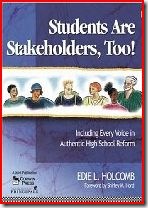
Image
While I had the flu, I picked up Edie Holcomb’s book, Students Are Stakeholders, Too .  It combines research on high school reform with practical strategies for engaging students. The book is presented as a case study, based on a composite of the man y schools she has worked with as a consultant.  The author contends that “Students can be visionaries, advocates, and change agents--- when given the permission, expectation and some guidance” (Holcomb, 2007, p. 7). I doubt high school reform will ever be simple, but imagine if students as well as staff were helping to craft and carry out a school improvement plan! CONNECTIONS: As we looked at all the AYP Success stories from last school year (schools with high growth or high growth/high achievement) the single thing that stood out from all the school stories was a focus on RELATIONSHIPS!

Implementation

I recently posted the 80/20 Rule Applied to School Improvement in the post I urge district and building leaders to put more effort into implementation than writing a school improvement plan. One of my very astute colleagues, Lori Stollar from IU 12, asked me how would we help districts focus on implementation? “Resting not on my own understanding,” I put it back to you my esteemed school improvement gurus.. What would a focus on implementation look like? What specific behaviors, tools, and actions should we bring to the attention of school improvement teams?

The 80/20 Rule

Image
I recently posted the Five Reasons School Improvement Plans Fail , a cautionary tale featuring the dark side of school improvement. While I think the post offers a good analysis on the common pitfalls of school reform – thanks to DuFour and Eaker, I am not entirely comfortable with the post. It highlighted pitfalls without shaping strategies for avoiding them. The first strategy that came to mind is the 80/20 Rule also known as Pareto’s Principle. The 80/20 Rule - “20 percent of something is always responsible for 80 percent of the results.” Think about how school teams spend their time. How many hours do they spend writing the plan? How many school improvement team meetings do they have after the plan is completed? In my experience teams spend about 80% of their time writing school improvement plans and 20% of their time implementing them. Reframing School Improvement Pareto’s Principle would suggest the inverse. Teams should be focusing 20% of their effort on id...

Reasons School Improvement Plans Fail

Rick DuFour & Robert Eaker list five reasons why school reform has failed in their book Professional Learning Communities at Work . Complexity of the task Misplaced focus Lack of clarity of intended results Lack of perseverance Failure to appreciate and attend to the change process. Here’s how I see these five areas playing out: Schools are complex organizations. Educators are great at identifying problems. We catalog and sort every wart and blemish. In fact, we are so good at it that we are become consumed with finding problems. We do not take the time to find the most strategic item we could tackle to get results… otherwise termed root cause . Complexity of the plan then leads to ambiguous results or expectations. For example, what does co-teaching mean to the Administrators? Special education teachers? Content area teachers?  Does co-teaching mean implementation of one model of co-teaching…. generall...

Reflections on Improvement

Sometimes my job is really fun! As part of our school improvement grant this year, I interviewed a variety of principals and assistant principals regarding their AYP success .  What became apparent fairly quickly was that success was not built on a specific initiative. In fact schools that did not have large gains in student achievement looked similar on paper. So what is the discernable difference? Here are some common characteristics of the AYP Success Schools: Sustained building leadership Sustained building vision Patience - Buildings had long-term plans – 5 to 10 years in most cases Relationships and culture were primary considerations. Leaders consciously and strategically built relationships between: Building leadership and teachers Teachers to teachers and Teachers to students Focus on implementation.  Many teams got lost here… focusing on providing the two hours of professional development mentioned in the plan. ...

Principle 1: Master the Courage to Interrogate Reality

This is the follow up to the Fierce Conversations post. I left the book club thinking how we could leverage Principle 1: Master the Courage to Interrogate Reality for school improvement. When we work with school improvement teams we see a nearly universal response. High school says if only the middle school had done its job, and the middle school says kids are not coming prepared. Other favorites include lack of motivation, students moving into the district, or it’s the parents. Let’s Interrogate Reality: When data is the foundation, we often see a different trend. High elementary scores, down slightly at middle school, then a sharp decrease at high school. NAEP data suggest the lower grades are beginning to close the achievement gap, while the gap is widening at the high school level. So in the words of Fierce Conversations author, Susan Scott, “What are we pretending not to know?” “What is our (administrators and teachers) contribution to the problem?” When will we b...

Fierce Conversations

Image
Fierce Conversations by Susan Scott was the featured at our administrative book club this year. True to its title the book boldly described the need and the process for having critical conversations both at home and the work place. The book resonates with sound, practical advice. For a taste of the author’s edgy wisdom read on: “I don’t know about you, but I have not yet witnessed a spontaneous recovery from incompetence” (p. 60). “As a leader, you get what you tolerate” (p. 60). “What are you pretending not to know” (p. 70). “Sometimes we put so many pillows around a message that the message gets lost altogether” (p. 144). “Identify your contribution to the problem” (p. 151). Stay tuned as we apply Principle 1: Master the Courage to Interrogate Reality to school improvement. Scott, S. (2003). Fierce conversations: Achieving success at work and in life one conversation at a time. New York: Berkley Book.

Libraries as the Hub of School Improvement

Image
I love school improvement! It sounds geeky and surreal, but it’s true. I practically get goose bumps talking about continuous improvement and high leverage instructional strategies. We have worked hard at our IU to offer comprehensive services to support our school districts and truly thought we had most of the territory covered. However, turns out we never considered the role of school libraries as a source of school improvement. Summary of Research Concludes (Findings from 19 State and 1 Province including Pennsylvania) : “A substantial body of research since 1990 shows a positive relationship between school libraries and student achievement. The research studies show that school libraries can have a positive impact on student achievement—whether such achievement is measured in terms of reading scores, literacy, or learning more generally. A school library program that is adequately staffed, resourced, and funded can lead to higher student achievement regardless of the soc...

Hiring Practices to Promote Culture

I recently stumbled upon the The Science Leadership Academy website. I noticed they had some employment opportunities…. I was intrigued by their top requirement for applicants, “to teach kids before they teach subjects.” Simple, but profound! It is fairly accepted that elementary teachers get into education because they love kids, while secondary teachers enter the profession because they love their content. While deep content knowledge is important, it should not overshadow the need for a student-centered classroom. We typically assess applicants for their content knowledge, but no where have I seen so clear a statement about the type of culture a school is trying to cultivate than I did when I saw The Science Leadership Academy’s requirement. It inspired me to think more critically about the hiring procedures we use in our office including job postings. According to their home page: The Science Leadership Academy is a partnership high school between the School District of Philadelp...