Posts

Showing posts with the label reading apprenticeship

Inquiry

Image
According to wikipedia, negative space is defined, in art, as “the space around and between the subject(s) of an image. Negative space may be most evident when the space around a subject, and not the subject itself, forms an interesting or artistically relevant shape, and such space is occasionally used to artistic effect as the "real" subject of an image. The use of negative space is a key element of artistic composition .” In other words the absence of color can be very powerful. This seems like a good analogy for the power of the inquiry process. In other words, as facilitators we do not need to color every question or comment with our own experience, thoughts or expertise. There is wisdom in saying or telling less. We can use our content knowledge to ask deep questions and solicit wisdom from our participants. This will ultimately have more impact on our audience because they can reflect and internalize information more efficiently. It is a difficult balance. I kno...
Join Us

Life has been pretty exciting lately, hence my blogging absence. My husband and I, in our infinite wisdom, moved mid school year. Just all kinds of fun with our two children and both us working in education! In addition, I added just a few job responsibilities. I am fortunate to be working with the Strategic Literacy Initiative, part of WestEd, a regional research lab, to coordinate Pennsylvania’s effort with implementing Reading Apprenticeship, an instructional framework to address content area literacy. Part of my efforts include contributing to their blog. Check out my new post, Report from Winter Conference: Reading Apprenticeship for Students with a Range of Needs . In the post, I share suggestions and examples regarding overcoming the challenging literacy needs that students sometimes bring to the high school level. What do you think? Can these ideas work?

Social Dimension

Image
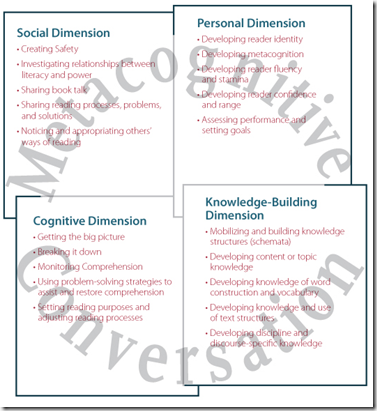
In my last post, I shared an article by Ed Week that highlighted the nonacademic skills needed for college and career success . The article brought me back to the framework for Reading Apprenticeship, an approach to adolescent literacy. The framework is posted to the right. When I was first introduced to the Reading Apprenticeship framework my initial thought was the social and personal dimensions were just like cotton candy…. looks good, tastes good, but not much substance. I have come to realize how very wrong I was. In fact, the personal and social dimensions are the very strength of the model. Look to the framework and ask yourself … Where do secondary teachers live? Where do students live? Most educators would say secondary teachers are focused on knowledge-building, while most say students value the social dimension over the others. It just is not realistic to think we will inspire deep content knowledge without valuing individual students and their need for soci...

Dispositions for Success

Today I was catching up on some reading and ran across an article in Ed Week entitled, Experts Begin to Identify Nonacademic Skills Key to Success . “[T]he biggest predictor of success is a student’s conscientiousness, as measured by such traits as dependability, perseverance through tasks, and work ethic. Agreeableness, including teamwork and emotional stability were the next-best predictors of college achievement, followed by variations on extroversion and openness to new experiences.” What caught my eye was not the actual article, although I did find that interesting, rather it was the reaction to the article in the comments section. Many of the comments were rather negative, defensive even. Some even stating it is only through Charters and other private education institutions that these skills can be emphasized. Others were critical indicating this is not the job of schools, rather parents and community members should take the lead. Why is it that so many of us think it ...

Having a Voice

Image
I recently had the great misfortune to contract tonsillitis. Out of the myriad of unpleasant symptoms, the one that was the most difficult was loosing my voice. It was frustrating not to be heard. There were a few situations, especially with larger groups of people, when I started to withdraw from the conversation. It was just too much effort. This experience made me appreciate the value of Reading Apprenticeship, an approach to secondary literacy through the Strategic Literacy Initiative at WestEd. The Reading Apprenticeship framework focuses on students developing, expanding and building the confidence in their voice in discipline specific ways. In a traditional secondary classroom, it is not unusual for the main modality of learning to be lecture. Students sit, listen and regurgitate on demand. The teachers do most of the work and students are peripheral to the learning process. In converse, Reading Apprenticeship classrooms have students at their center. Students a...

A Head of the Curve

This summer's Governor's Institute unveiled the Standards Aligned System (SAS) and the curriculum framework in math and literacy. Math is not my area of strength, but I decided to attend the math sessions and I was glad I did. I learned a lot about mathematics and found several exciting connections. First, the week long training provided by the Governor's Institute entitled, Developing Mathematical Ideas (DMI), is exactly the same training we have been offering at the IU for the last several years. We are ahead of the curve and are well poised to enhance our existing training with the Mathematics Curriculum Framework created by PDE. Second, the facilitators began each module with mental math. I was struck how closely the process paralleled a Reading Process Analysis in Reading Apprenticeship. The mental math activity slowed down thinking and helped to surface mathematical understanding as well as strategies for solving problems. I have long wondered how to make content...